The Mortgage Industry Doesn’t Need Another CRM. It Needs an Operating System.
14 September 2026 · Fraser Hamilton
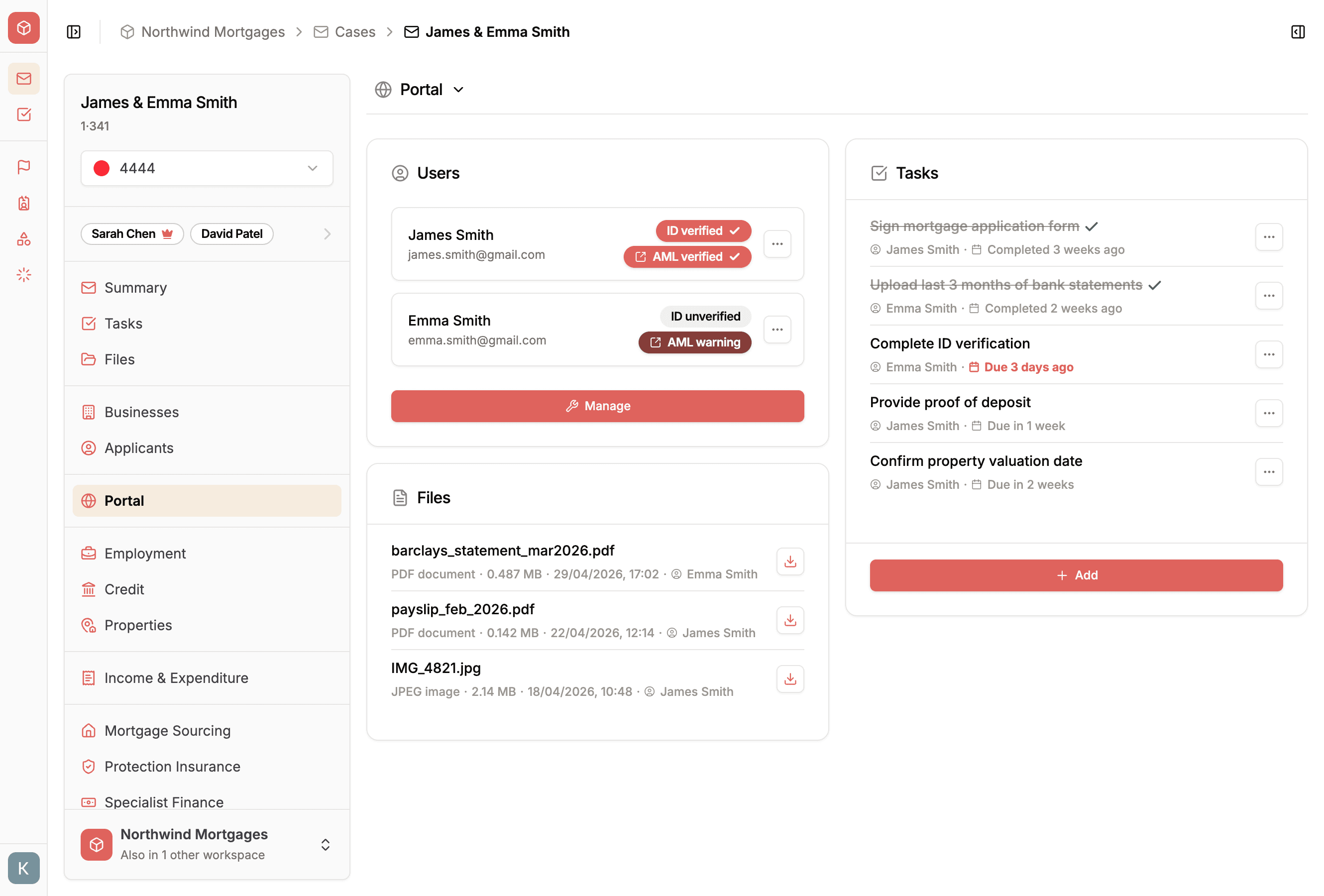
For years, mortgage technology has been built around one basic idea:
Store the information.
Store the client.
Store the case.
Store the documents.
Store the notes.
Store the tasks.
And then rely on people to keep everything up to date.
That model made sense when the alternative was paper files, spreadsheets and disconnected databases.
But the industry has moved on.
The problem is that much of the technology hasn’t.
Too many advisers, administrators and compliance teams are still spending their day operating software rather than being supported by it.
They enter information.
They re-key it.
They upload documents.
They chase missing documents.
They update stages.
They create tasks.
They write case notes.
They check whether somebody else has completed something.
They generate documents.
They review files.
They move data between systems.
Then management asks why productivity hasn’t improved despite having invested heavily in technology.
The answer is relatively simple.
We digitised the administration.
We didn’t remove it.
A CRM records what happened
At its core, a traditional CRM is a system of record.
It tells you who the client is.
It tells you where the case is.
It tells you what activity has taken place.
That is useful.
But it is no longer enough.
The next generation of mortgage technology shouldn’t simply record what people have done.
It should understand what is happening and help determine what needs to happen next.
That is a fundamentally different proposition.
A mortgage operating system should be able to understand the context of a case, recognise missing information, interpret documents, trigger actions, support recommendations, identify risks and keep work moving without requiring somebody to manually orchestrate every step.
The difference sounds subtle.
It isn’t.
One system waits for somebody to update it.
The other actively participates in running the business.
Software should be doing more of the work
Think about a typical mortgage journey.
A client speaks to an adviser.
Information is collected.
Documents arrive.
The case is assessed.
Products are sourced.
Recommendations are made.
Compliance requirements are satisfied.
The application progresses.
The client needs updates.
Administrators need tasks.
Managers need visibility.
Compliance teams need oversight.
Every one of those stages creates administrative work.
Historically, technology has helped organise that work.
AI now gives us the opportunity to remove a significant amount of it.
A conversation can become structured client information.
A document can be read and understood automatically.
Missing information can be identified without somebody manually checking a file.
A case can generate its own tasks based on what is happening.
A suitability document can be created from information already held within the case.
Potential compliance issues can be surfaced before a file reaches formal review.
Management can see where cases are slowing down without asking advisers for updates.
That changes the role of technology completely.
The objective should no longer be:
How do we make advisers faster at using the CRM?
It should be:
How much of the CRM work can we remove from the adviser altogether?
AI shouldn’t be another tool advisers have to operate
This is where I think the industry needs to be careful.
We are starting to see AI added everywhere.
AI note takers.
AI assistants.
AI document tools.
AI letter generators.
AI chatbots.
Many of these products are genuinely useful.
But if we simply give advisers another six AI applications to manage, we risk repeating the same mistake.
The adviser ends up with another collection of tools.
More tabs.
More logins.
More data moving between systems.
More integrations.
More things to remember.
The real opportunity is not adding AI beside the workflow.
It is putting intelligence inside the workflow.
The technology should understand the case because the case already exists inside the system.
It should understand the documents because they are already attached to the client.
It should understand what stage the case is at because it has visibility of the workflow.
It should understand what the adviser has done, what still needs to happen and where something looks unusual.
AI becomes significantly more powerful when it has context.
And the mortgage platform is where that context lives.
The biggest opportunity may be compliance
This becomes even more interesting when you move beyond adviser productivity.
Most mortgage businesses still operate compliance models heavily dependent on retrospective review.
A case is completed.
A percentage of files are sampled.
Someone manually reviews them.
Issues are identified.
Feedback is given.
That model exists partly because historically there was no practical way to continuously analyse every case.
AI changes that equation.
Imagine a compliance model where technology is assessing cases as they progress.
Is required information missing?
Does something contradict information elsewhere in the file?
Has the rationale been adequately documented?
Are unusual patterns developing?
Does this case warrant greater scrutiny than others?
Does a particular adviser require additional support?
That doesn’t mean replacing experienced compliance professionals.
Quite the opposite.
It means allowing them to focus their expertise on the cases and issues where human judgement genuinely matters.
The future of compliance shouldn’t be less human oversight.
It should be better-targeted human oversight.
Networks have an even bigger problem
For mortgage networks, the limitations of traditional technology become more pronounced.
A network doesn’t simply need to understand one adviser or one case.
It needs visibility across multiple firms, advisers, workflows and risk profiles.
Historically, that has required enormous amounts of reporting, sampling and manual supervision.
An operating system designed for that environment should do far more than provide a dashboard.
It should help answer questions such as:
Which firms need attention?
Which advisers are generating unusual patterns?
Where are cases consistently slowing down?
Where is information repeatedly missing?
Which areas are generating increased compliance risk?
Where might training or supervision be required?
What is happening across the network right now?
And increasingly:
What should we do about it?
That shift from reporting to intelligence is important.
A dashboard tells you what happened.
An intelligent operating system should help you decide what happens next.
The future is systems of action
Enterprise software has historically moved through different phases.
First came systems of record.
Then systems of workflow.
I believe we are now entering the era of systems of action.
Systems that don’t simply contain information.
They understand it.
They connect it.
They reason across it.
And increasingly, they act upon it.
Mortgages are particularly well suited to this transformation because so much of the workload surrounding advice is structured, repetitive and process-driven.
There are rules.
Documents.
Stages.
Requirements.
Dependencies.
Checks.
Tasks.
Notifications.
Reviews.
That doesn’t mean mortgage advice itself becomes automated.
Advice is deeply human.
Understanding circumstances, explaining options, building trust and applying judgement will remain at the centre of the adviser relationship.
But much of the machinery surrounding that advice does not need to remain human-operated.
That is where the opportunity lies.
This isn’t about replacing people
Whenever AI and automation are discussed, the conversation quickly becomes one about jobs.
I think that misses the point.
The best mortgage businesses don’t have too many good advisers.
They have too much work preventing good advisers from advising.
They don’t have too many talented administrators.
They have talented administrators spending time on repetitive tasks that technology should increasingly handle.
They don’t have too many compliance professionals.
They have experienced compliance professionals spending valuable time manually searching for issues technology could help surface automatically.
The purpose of better technology should be to increase the leverage of good people.
Give advisers more time with clients.
Give administrators more capacity.
Give compliance teams better visibility.
Give managers better information.
Give networks better oversight.
That is a much more interesting future than simply building a slightly faster CRM.
So what comes after the CRM?
I don’t think the CRM disappears overnight.
Systems of record remain important.
Data still needs to live somewhere.
But the centre of gravity is changing.
The winning mortgage platforms of the next decade will not be judged primarily by how well they store client information.
They will be judged by how much work they remove.
How intelligently they coordinate the business.
How well they connect people, processes and data.
How early they identify problems.
How much operational capacity they create.
And how effectively they allow firms to scale without administration scaling at exactly the same rate.
That is why I believe the mortgage industry doesn’t need another CRM.
It needs an operating system.
One that doesn’t simply record the work.
One that helps do the work.